

In the Buddha’s teaching, it is said:
Dig pa che ya mi ja zhing, Ge wa phun sum tsok par che, Rang gi sem nyi yong su de, De ni sang gye ten pa yin
Don’t practice non-virtue, enthusiastically practice virtue, watch your mind and train your mind.
That is how you practice the spiritual path of the Buddha’s teaching. The meaning of practicing spiritual practice — practicing the dharma — is to transform our heart.
As you grow up, slowly, with help from others and by yourself, you train your mind a little better, and you stop doing crazy things. You learn through experience, but that alone won’t make you perfect.
On top of that, we practice the Dharma — we listen to the Buddha’s teachings because the Buddha is wise and teaches us how to be compassionate — teaching us true kindness, true compassion, which we need.
Sometimes we think we’re compassionate, but we’re not; because of a lack of education, a lack of wisdom. So, through the Buddha’s teaching, we speak to our own hearts: don’t be greedy, don’t be selfish, don’t be gullible; always consider things from every side, always think before acting, and train yourself to do more good things and fewer bad things.
It’s not only about transforming your heart. It’s also about perfecting your actions in daily life, doing more good and less harm. So the Buddha’s teaching says the first thing is to avoid non-virtuous actions; cheating others, lying to others, and all kinds of harm —not only toward human beings, but also toward animals and even plants.
That’s the first part of the Buddha’s teaching. Don’t do non-virtue. Then, training the mind is one thing; training your actions is another.
So in ordinary life, you avoid causing harm and develop the habit of helping others — mainly practicing virtue. But how can you practice virtue continuously? How can you be kind all the time?
So to practice kindness and virtue continuously, you need to cultivate a genuinely good heart. There are two things: training the mind means the mind is wild, and you have to keep telling it, “Don’t do that, don’t do that.” And practicing a virtuous mind means cultivating a warm heart, prioritizing true kindness inside you. So, as a spiritual practitioner, how do you generate a virtuous mind on a daily basis, even when nothing is happening, like today, when it is just raining, nothing happening? You can still sit down and cultivate your virtuous mind.
Even if you have no one to interact with, through visualization you can practice generosity, patience, and so on.
So it matters — not only what you do with people, but also how you cultivate good energy inside yourself, how you develop true compassion within you. So, a daily spiritual practice gives you a lot of opportunity to develop
kindness and a positive, virtuous mind inside you. That’s why people look for a daily practice — especially something with structure, something with a bit of ritual in it.
So, how do you structure one day of practice? People who have a shrine or altar, how do they think about it? They don’t just sit down and meditate directly by following the instructions. First you clean the place, put everything in order, arrange the offerings, decorate the space. Then you sit down. And before you actually meditate, you first set your motivation for the session and address any non-virtuous action or mistake you’ve made in the past. Even if it was something you did yesterday; how you may have upset someone, and how you can fix it, by purifying any misdeeds. In this way you learn how to reduce and eliminate bad karma, and how to accumulate positive karma every day.
Once you have the instructions and follow them every day, even if it only takes fifteen minutes, you can do a lot. When you think about fifteen minutes, what do you actually do with fifteen minutes? Tell me. You just look at your phone and it’s already gone to thirty. So fifteen minutes seems like nothing, but you can do a lot in that time if you care about those fifteen minutes. Every day, fifteen minutes: you clean the place where you sit, then you sit and meditate. Do this every day.
Helping yourself is helping others. If you look closely, someone who takes care of themselves isn’t burdening others, and eventually doesn’t become a burden to anyone else either. In this way you develop your kindness, your patience, your motivation. For the practice of the Four Immeasurables, doing this every day, even just fifteen minutes, is helping you to develop a stronger heart, so that you can be continuously kind to others, continuously practice virtue and continuously do good things.
When we say, “preliminary practice” these are foundational, important practices. If you skip them and try to move straight to something more advanced, you may get some result, but not the best result. And especially as you build further, you’ll run into trouble. So even if you can’t do anything else, every day, get up, wash your face, do whatever you normally do, and then just sit down and relax for three minutes. Motivate yourself,
“Today, on this day, I will reduce harm to others, I will try to do something good and helpful, I will be nice to others”
If you set this motivation every time, even in just one or three minutes, this benefits not only your future, but you’ll also have a better day that day. You will have a nice day. In the morning you first motivate yourself to be patient and kind, then when you see something out of place, you won’t lose your temper right away.
That’s the key. As you grow through life, if you learn this technique and set your motivation every morning, it becomes a habit — resetting yourself properly each morning. You become more patient, more friendly, and you transform into a better human being.
You may think you’re good because deep in your heart you have no evil intention. But your actions, the way you talk to people, the way you treat them —your behavior— may not be good. That’s something you need to work on as you grow up, so that you can become a truly beneficial person in the world.
In your daily practice, when you’re wishing “may all beings be happy” — as in the Four Immeasurables — you care more about others’ happiness rather than your own, and then if others don’t do what you expect of them, you can accept it and be okay with that, rather than getting upset with them.
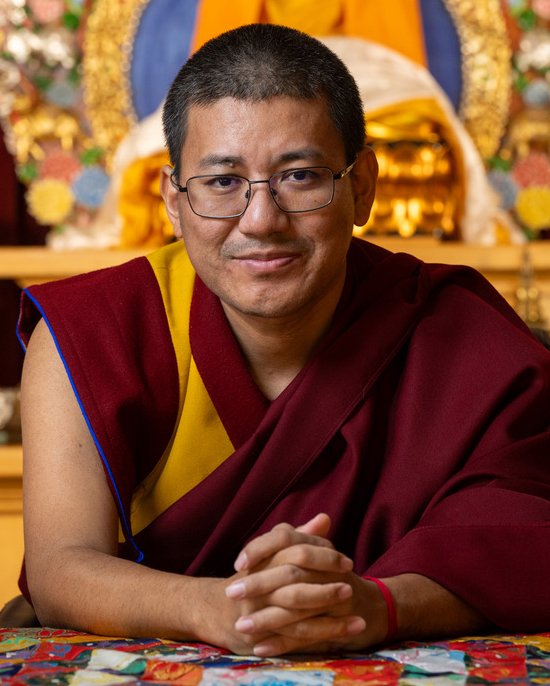
Developing a Daily Dharma Practice (Demo Rinpoche – Ancient Wisdom. Modern Times. #284 July 6, 2026)